Science5.9° S, 42.7° E
Thermal Ellipsoids
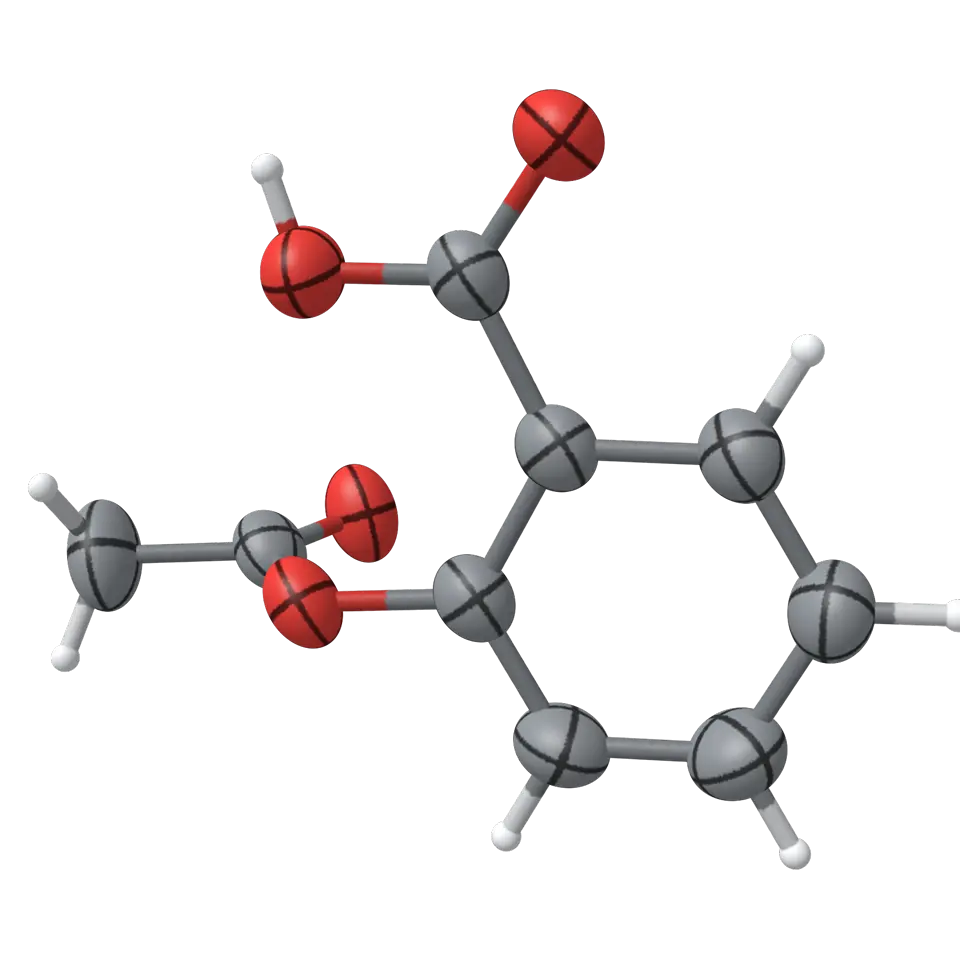
Crystallography describes an atom's average position and spread with a displacement tensor.
- Kind
- Built from a recipe
- Your own
- Your own crystal structure
- Sound
- Yes
- Licenses
- CC0
How to play
Tap to make the atoms jiggle. Zoom in, then tap an atom to look there. Open your own CIF in the Splash tab.
Its controls
| Control | Kind | Range | Start |
|---|---|---|---|
| Jiggle the atoms | Tap | ||
| Jiggle | Switch | Off | |
| Zoom in | Slider | 0 to 100% | 0% |
| Look there | Button | ||
| Structure | List | 42 choices | Aspirin |
| Show | List | 3 choices | What suits it |
| Probability | List | 3 choices | 50% (the usual) |
| Draw each atom as | List | 2 choices | A solid ellipsoid |
| Bonds | Setting | ||
| Hydrogens | List | 3 choices | Small spheres (the usual) |
About it
Crystallography describes an atom's average position and spread with a displacement tensor. An ellipsoid is a Gaussian picture of that spread, which can include vibration and static disorder; its long axis shows the direction of greatest spread. It is not a photograph of an atom's motion.
Pick one of 41 measured structures in seven groups (everyday molecules, medicines, molecules of life, minerals and gems, ice and salts, proteins, and DNA and RNA) from the Crystallography Open Database or the Protein Data Bank, or open a CIF, mmCIF or PDB file. Show fills the unit cell with the atoms' symmetry copies, as minerals show by default. Probability sets the ellipsoid to enclose 30%, 50% or 90% of the spread; hard minerals and cold crystals have small ones. Draw solid ellipsoids or one Gaussian per atom, with or without bonds; hydrogens can be small spheres, as refined, or hidden. Tap to jiggle; zoom in, then tap an atom to focus there. Files stay on your device. Use it to explore, not to measure.
Details
- Splats
- Opens at 200,000 at Mid Detail, 36,001 at Low, and up to 360,000 at Max
- Your own files
- .cif, .mmcif, .pdb, .ent, .txt
Sources and credits
| Work | By | License |
|---|---|---|
| Table sugar (sucrose) (COD 2300557) | A. O. Dmitrienko and I. S. Bushmarinov (Journal of Applied Crystallography 48, 2015), via the Crystallography Open Database | CC0 1.0 (Crystallography Open Database) |
| Urea (COD 1566505) | P. N. Ruth, R. Herbst-Irmer and D. Stalke (IUCrJ 9 286, 2022), via the Crystallography Open Database | CC0 1.0 (Crystallography Open Database) |
| Vitamin C (ascorbic acid) (COD 2300646) | C. J. McMonagle and M. R. Probert (Journal of Applied Crystallography 52 445, 2019), via the Crystallography Open Database | CC0 1.0 (Crystallography Open Database) |
| Vanillin (the taste of vanilla) (COD 7242089) | S. Sundareswaran and S. Karuppannan (CrystEngComm 23 1634, 2021), via the Crystallography Open Database | CC0 1.0 (Crystallography Open Database) |
| Capsaicin (the heat of chili peppers) (COD 2312782) | M. Lozinšek (Acta crystallographica. Section C, Structural chemistry 81 188, 2025), via the Crystallography Open Database | CC0 1.0 (Crystallography Open Database) |
| Aspirin (COD 2104857) | E. J. Chan, T. R. Welberry, A. P. Heerdegen and D. J. Goossens (Acta Crystallographica Section B 66 696, 2010), via the Crystallography Open Database | CC0 1.0 (Crystallography Open Database) |
| Acetaminophen (paracetamol) (COD 7232757) | M. R. Ward and I. D. H. Oswald (CrystEngComm 21 4437, 2019), via the Crystallography Open Database | CC0 1.0 (Crystallography Open Database) |
| Ibuprofen (neutron) (COD 2006278) | N. Shankland, C. C. Wilson, A. J. Florence and P. J. Cox (Acta Crystallographica Section C 53 951, 1997), via the Crystallography Open Database | CC0 1.0 (Crystallography Open Database) |
| Vitamin B3 (nicotinamide, neutron) (COD 2003053) | Y. Miwa, T. Mizuno, K. Tsuchida et al. (Acta Crystallographica, Section B 55 78, 1999), via the Crystallography Open Database | CC0 1.0 (Crystallography Open Database) |
| Salicylic acid (from willow bark) (COD 2100548) | P. Munshi and T. N. Guru Row (Acta Crystallographica Section B 62 612, 2006), via the Crystallography Open Database | CC0 1.0 (Crystallography Open Database) |
| Morphine (COD 2237167) | T. Gelbrich, D. E. Braun and U. J. Griesser (Acta Crystallographica Section E 69 o2, 2013), via the Crystallography Open Database | CC0 1.0 (Crystallography Open Database) |
| Glycine, an amino acid (neutron) (COD 2103308) | P. Langan, S. A. Mason, D. Myles and B. P. Schoenborn (Acta Crystallographica Section B 58 728, 2002), via the Crystallography Open Database | CC0 1.0 (Crystallography Open Database) |
| Cytosine, a letter of DNA (COD 2019803) | B. Sridhar, J. B. Nanubolu and K. Ravikumar (Acta Crystallographica Section C 71, 2015), via the Crystallography Open Database | CC0 1.0 (Crystallography Open Database) |
| Guanine, a letter of DNA (COD 2015488) | K. Guille and W. Clegg (Acta Crystallographica Section C 62 o515, 2006), via the Crystallography Open Database | CC0 1.0 (Crystallography Open Database) |
| Serotonin, a messenger in the brain (COD 2244048) | M. Naeem, A. R. Chadeayne, J. A. Golen and D. R. Manke (Acta Crystallographica Section E 78, 2022), via the Crystallography Open Database | CC0 1.0 (Crystallography Open Database) |
| NAD+, a helper molecule in every cell (COD 1507221) | B. Guillot, N. Muzet, E. Artacho et al. (The Journal of Physical Chemistry B 107 9109, 2003), via the Crystallography Open Database | CC0 1.0 (Crystallography Open Database) |
| Alanine, the simplest amino acid with a side chain (COD 8000310) | L. A. Malaspina, E. K. Wieduwilt, J. Bergmann et al. (The Journal of Physical Chemistry Letters 6973, 2019), via the Crystallography Open Database | CC0 1.0 (Crystallography Open Database) |
| Histidine, an amino acid (neutron, 5 K) (COD 2108879) | G. Novelli, C. J. McMonagle, F. Kleemiss et al. (Acta Crystallographica Section B 77, 2021), via the Crystallography Open Database | CC0 1.0 (Crystallography Open Database) |
| Thymidine, a building block of DNA (COD 2104143) | C. B. Hübschle, B. Dittrich, S. Grabowsky et al. (Acta Crystallographica Section B 64 363, 2008), via the Crystallography Open Database | CC0 1.0 (Crystallography Open Database) |
| Quartz (COD 9000775) | L. Levien, C. T. Prewitt and D. J. Weidner (American Mineralogist 65 920, 1980), via the Crystallography Open Database | CC0 1.0 (Crystallography Open Database) |
| Calcite (COD 9000965) | S. A. Markgraf and R. J. Reeder (American Mineralogist 70 590, 1985), via the Crystallography Open Database | CC0 1.0 (Crystallography Open Database) |
| Corundum (ruby and sapphire) (COD 1000032) | L. Lutterotti and P. Scardi (Journal of Applied Crystallography 23 246, 1990), via the Crystallography Open Database | CC0 1.0 (Crystallography Open Database) |
| Beryl (emerald) (COD 9000992) | G. E. Brown and B. A. Mills (American Mineralogist 71 547, 1986), via the Crystallography Open Database | CC0 1.0 (Crystallography Open Database) |
| Zircon (COD 9000684) | R. M. Hazen and L. W. Finger (American Mineralogist 64 196, 1979), via the Crystallography Open Database | CC0 1.0 (Crystallography Open Database) |
| Garnet (pyrope) (COD 2108142) | R. Destro, R. Ruffo, P. Roversi et al. (Acta Crystallographica Section B 73 722, 2017), via the Crystallography Open Database | CC0 1.0 (Crystallography Open Database) |
| Pyrite (fool's gold) (COD 1564890) | K. Ma, R. Lefèvre, Q. Li et al. (Chemical Science, 2021), via the Crystallography Open Database | CC0 1.0 (Crystallography Open Database) |
| Ice from Antarctica (neutron) (COD 9015208) | A. D. Fortes, I. G. Wood, D. Grigoriev et al. (Journal of Chemical Physics 120 11376, 2004), via the Crystallography Open Database | CC0 1.0 (Crystallography Open Database) |
| Rock salt (COD 7132177) | M. Mettler, A. Dewandre, N. Tumanov et al. (Chemical Communications, 2023), via the Crystallography Open Database | CC0 1.0 (Crystallography Open Database) |
| Gypsum (neutron) (COD 2300258) | P. F. Henry, M. T. Weller and C. C. Wilson (Journal of Applied Crystallography 42 1176, 2009), via the Crystallography Open Database | CC0 1.0 (Crystallography Open Database) |
| Blue vitriol (chalcanthite, neutron) (COD 9008253) | G. E. Bacon and D. H. Titterton (Zeitschrift fur Kristallographie 141 330, 1975), via the Crystallography Open Database | CC0 1.0 (Crystallography Open Database) |
| Crambin, 0.54 Å (PDB 1EJG) | C. Jelsch, M. Teeter, V. Lamzin et al. (Proc.Natl.Acad.Sci.USA 97 3171, 2000), via the Protein Data Bank | CC0 1.0 (wwPDB data policy) |
| Lysozyme, 0.65 Å (PDB 2VB1) | J. Wang, M. Dauter, R. Alkire et al. (Acta Crystallogr.,Sect.D 63 1254, 2007), via the Protein Data Bank | CC0 1.0 (wwPDB data policy) |
| An iron-sulfur protein (HiPIP), 0.48 Å (PDB 5D8V) | Y. Hirano, K. Takeda and K. Miki (Nature 534 281, 2016), via the Protein Data Bank | CC0 1.0 (wwPDB data policy) |
| Rubredoxin, 0.68 Å (PDB 2DSX) | C. Chen, Y. Lin, Y. Huang and M. Liu (Biochem.Biophys.Res.Commun. 349 79, 2006), via the Protein Data Bank | CC0 1.0 (wwPDB data policy) |
| B-DNA, 0.74 Å (PDB 1D8G) | C. Kielkopf, S. Ding, P. Kuhn and D. Rees (J.Mol.Biol. 296 787, 2000), via the Protein Data Bank | CC0 1.0 (wwPDB data policy) |
| A-DNA, 0.83 Å (PDB 1DPL) | M. Egli, V. Tereshko, M. Teplova et al. (Biopolymers 48 234, 1998), via the Protein Data Bank | CC0 1.0 (wwPDB data policy) |
| Z-DNA, 0.55 Å (PDB 3P4J) | K. Brzezinski, A. Brzuszkiewicz, M. Dauter et al. (Nucleic Acids Res. 39 6238, 2011), via the Protein Data Bank | CC0 1.0 (wwPDB data policy) |
| A four-stranded RNA, 0.61 Å (PDB 1J8G) | J. Deng, Y. Xiong and M. Sundaralingam (Proc.Natl.Acad.Sci.USA 98 13665, 2001), via the Protein Data Bank | CC0 1.0 (wwPDB data policy) |
| A loop of ribosomal RNA, 0.85 Å (PDB 5NQI) | C. Riml, A. Lusser, E. Ennifar and R. Micura (J. Org. Chem. 82 7939, 2017), via the Protein Data Bank | CC0 1.0 (wwPDB data policy) |
| DNA with a drug in its groove, 0.95 Å (PDB 3OMJ) | D. Chenoweth and P. Dervan (J.Am.Chem.Soc. 132 14521, 2010), via the Protein Data Bank | CC0 1.0 (wwPDB data policy) |
| DNA with a light-switch metal complex, 0.92 Å (PDB 4E1U) | H. Song, J. Kaiser and J. Barton (Nat Chem 4 615, 2012), via the Protein Data Bank | CC0 1.0 (wwPDB data policy) |
Nearby in the collection
Straight down
Through the middle of the world, the far side is Oak Tree, on Nature.
Fall throughIt stands 2.5° from the exact far side, the closest of any Splash.